
Digital Transformation is the keynote theme of every technology conference and one of the most important topics discussed everywhere- on the agendas of corporate boards, growth committee meetings and change management’s to do list. Across all industries, digital transformation is not a choice for incumbent players, it is a necessity. Yet, the uncomfortable truth is that at the outset of a digital transformation program, the odds are stacked against successful delivery. A digital transformation study from SAP, supported by Oxford Economics, reveals that 84% of those surveyed say digital transformation is critical to their survival in the next five years. But only three percent have completed company-wide transformation efforts. As per Wipro Digital survey, only 50% of companies are successfully executing on their digital transformation strategies despite demonstrated efforts and investments. Nearly 1 in 5 senior executives admit that they secretly believe that digital transformation projects in their company are a waste of time.

With all the talk about Digital Transformation, the inevitable question arises: Is it hype or is it real?
Following is a discussion that attempts at defining digital transformation with excerpts from various sources and outlines competitive advantages to facilitate discussions on strategies to overcome resistance for business and technology leaders to embrace digital transformation and debunk the “Digital Transformation” myth for an ambitious and successful future.
What Digital Transformation Is—and What It Isn’t
CIO.com article on digital transformation being a necessary disruption states the biggest contributor for the failure of an organization wide digital transformation initiative is lack of consensus on what digital transformation means. Ask 10 CIOs how they define digital transformation and you’re likely to get 10 different answers with one common theme: a laundry list of technology projects intended to foster sweeping business changes. Even so, digital transformation isn’t so easily defined. Surely, digital transformation involves a radical rethinking of how an organization uses technology in pursuit of new revenue streams or new business models. And it also requires cross-departmental collaboration in pairing business-focused philosophies with rapid application development models.
Digital Transformation Is Not Innovation
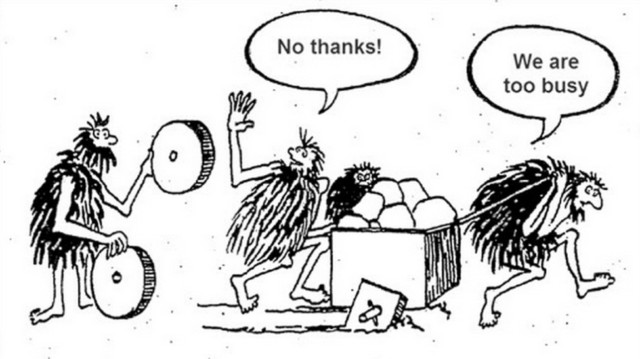
Eric Ng from Scalar elaborates correlation between Digital Transformation and Innovation in this article stating the human pursuit to innovate is relentless. The ability for us to continuously ask the question, “Is there to be a better way to do that?” is one of our greatest traits as a race. The aim of a digital transformation initiative is to help organizations meet the demands of an increasingly complex world that have been exacerbated by technology. But the reality is that if you aren’t changing and evolving as a business you a have a much larger problem on your hands than merely ‘becoming more digital’. The promise of digital transformation then is really a misnomer.
It’s not about digital or transformation. It’s about adaptation
Gerald C. Kane’s MIT Sloan‘ post identifies common misconceptions about digital transformation being something that companies choose to do with technology or is primarily about their implementation and use of technology. Instead, digital transformation is about how technology changes the conditions under which business is done, in ways that change the expectations of customers, partners, and employees.
Digital transformation is not about transformation. Looking up a number of definitions for the word “transformation” demonstrates that they exhibit a common characteristic — they all define transformation as a singular process that occurs and is then completed.
Digital transformation, however, does not work that way. It is not a process that will ever be complete, at least not in the near future. Moore’s Law continues to suggest that processing power per dollar doubles every 18 months. Storage capacity and networking speeds increase at an even faster rate (doubling every 12 and nine months, respectively). New classes of technologies — artificial intelligence, blockchain, autonomous vehicles, augmented and virtual reality — will likely become widely adopted over the coming decade or two, fundamentally changing expectations yet again. By the time you adapt to today’s digital environment, that environment will have likely already changed significantly.
So What is digital transformation about, then?
At its most fundamental level, digital transformation is about the ability of organizations, its leaders and employees, to adapt to rapid changes wrought by evolving digital technologies.
In spite of all the Digital technologies and related business innovations permeating society—introducing new cultures, reshaping the competitive landscape, raising customer expectations, disrupting established business models, creating unprecedented challenges—and opportunities—for companies everywhere, but what does it really mean to transform and how do business leaders build a framework to prioritize and execute?
Customer Experience is the core of a Digital Transformation Strategy
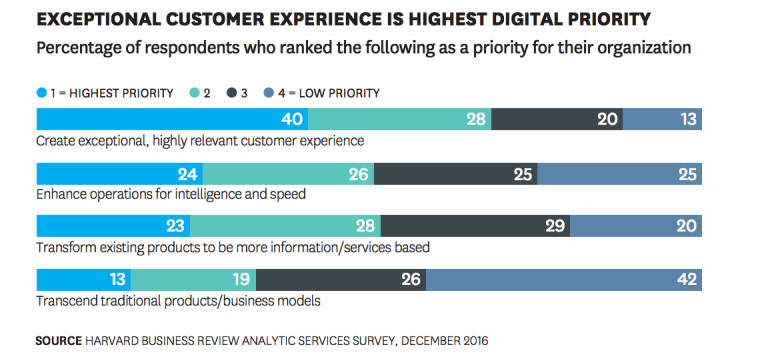
Harvard Business Review’s Analytics survey identifies the number priority for a Digital Transformation is creating exceptional and highly relevant customer experiences.
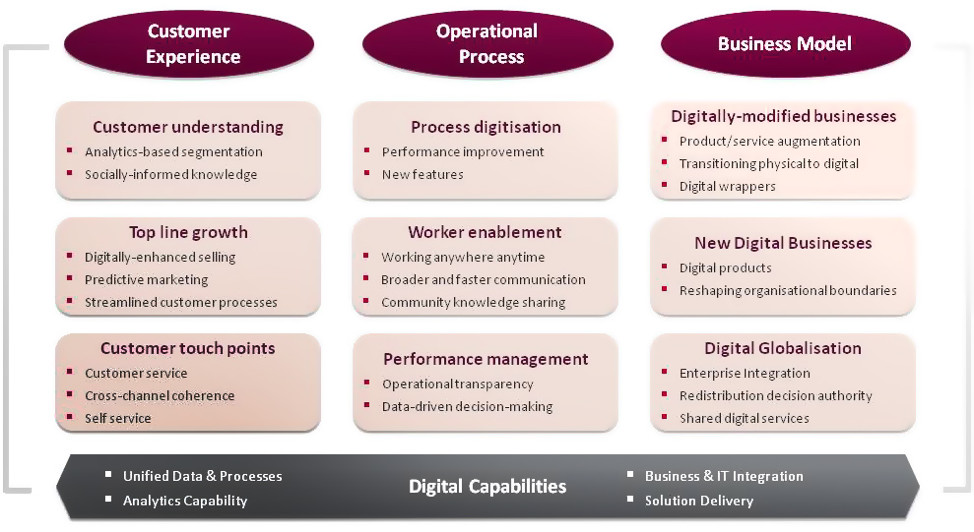
Capgemini and MIT Center for Digital Business in a three-year study defined an effective digital transformation framework as shown in the figure below:
Digital transformation challenges each company to rethink fundamental processes. Here is how Accenture’s internal IT organization is transforming many pieces of the digital puzzle across Accenture’s global operations
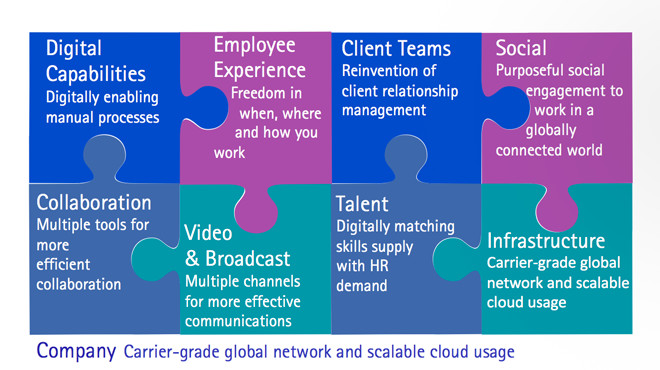
The take-away from this study is that in a digital business transformation context, all these aspects: business functions, processes, activities, assets, models, and activities are interconnected.This is an essential aspect of digital transformation: the inter dependency and inter-contentedness of everything. From business processes and models to business activities and each single activity of the organization.
What are the Enablers of Digital Transformation?
As per Deloitte’s take on Digital transformation being a strategic imperative, the following are some key digital enablers for business across any industry to consider.
—Connectivity. Transforming interactions and engagement models among internal and external stakeholders—including customers, employees, business partners and investors—by connecting people, spaces, products data and technology.
—Experience innovation. Wiring the organization to orchestrate and deliver a winning customer experience, such as using speech and gesture based interfaces, linked to artificial intelligence (AI) engines and bots.
—Data intelligence. Using data and analytics to uncover breakthrough business insights and develop products, services and experiences tailored to customer needs.
—Leading-edge innovation. Leveraging emerging technologies such as augmented and virtual reality, machine learning and AI—to create innovative products and services that help build competitive advantage.
—Automation. Using robotics and digital services to automate tasks that are currently done by humans—improving operations and ultimately delivering more engaging customer experiences.
—Cybersecurity. Implementing cutting-edge security to protect customer data—particularly sensitive information such as health or financial data that is transmitted over connected devices.
Alone, each one of these digital enablers could create opportunity, but sustainable advantage often comes from a combination of two or more—opening up new forms of business value.
Don’t Settle for Random Acts of Digital. When it comes to digital transformation, it’s critical to not view the end-goal as a digital device or technology initiative. Rather, the end-goal is creating a winning business model for the future—which is the true measure of digital transformation.
What are your thoughts on digital business transformation? What challenges do you face?